Stop Guessing, Start Tracking: 6 Golf Stats Every Junior (and Their Parents) Should Know
June 28, 2026 7 min read
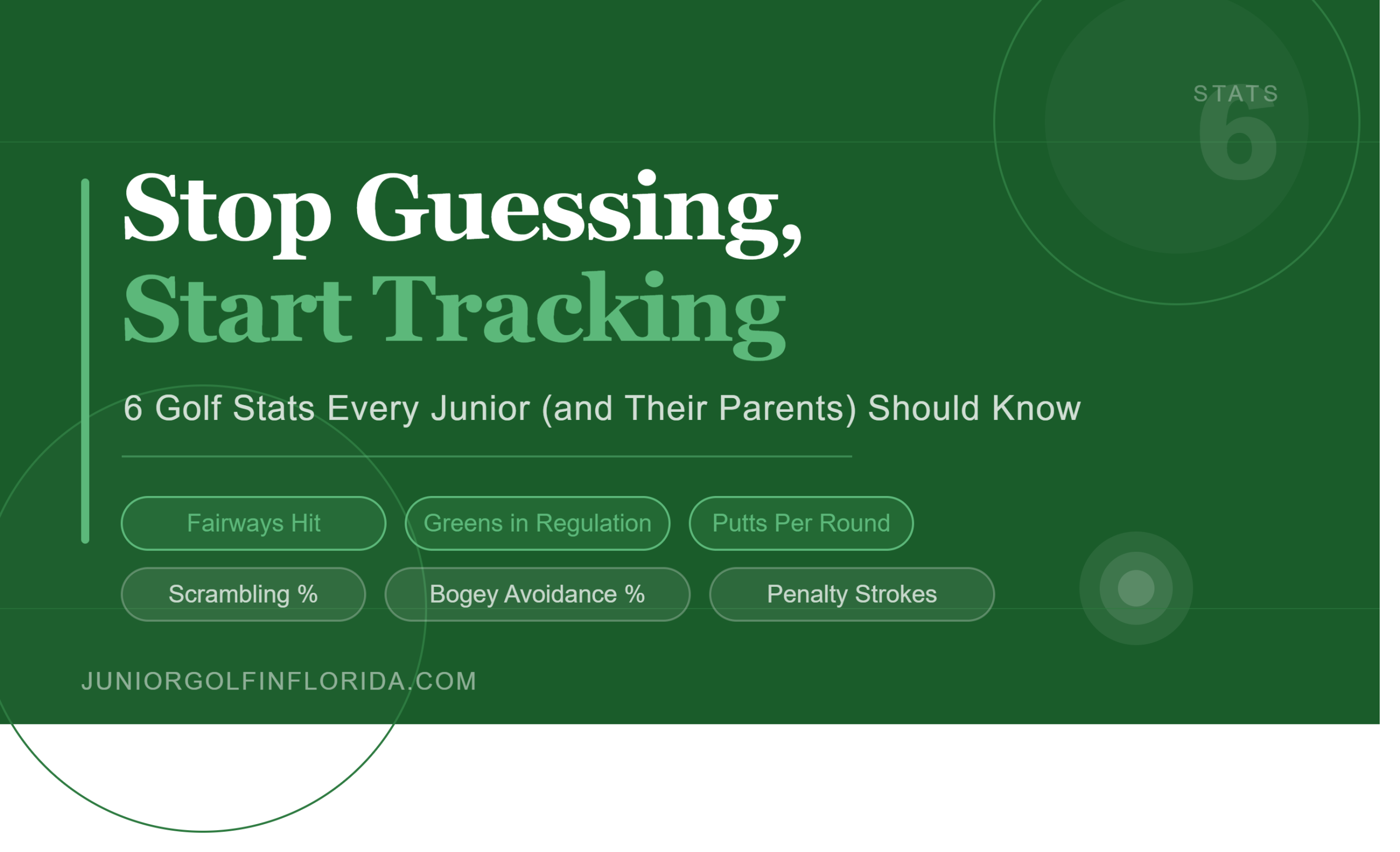
Scorecards tell you what happened. Stats tell you why. Here are the 6 golf stats every junior golfer — beginner or competitive — should be tracking, and how Florida families can use them to practice with real purpose.
Stop Guessing, Start Tracking: 6 Golf Stats Every Junior (and Their Parents) Should Know
Most junior golfers finish a round, hand in the scorecard, and move on. The score gets remembered. Everything else gets forgotten.
But for families who want to go further — whether that means breaking 90 for the first time or eventually earning a spot on a college roster — the scorecard is just the starting point. The real story is in the details behind the number.
Tracking golf statistics turns guesswork into a game plan. It helps your junior golfer stop practicing what they’re already good at and start fixing what’s actually costing them strokes. And the good news? You don’t need expensive software or a launch monitor to begin. A scorecard, a pencil, and a little consistency go a long way.
Why Stats Matter More Than Score Alone
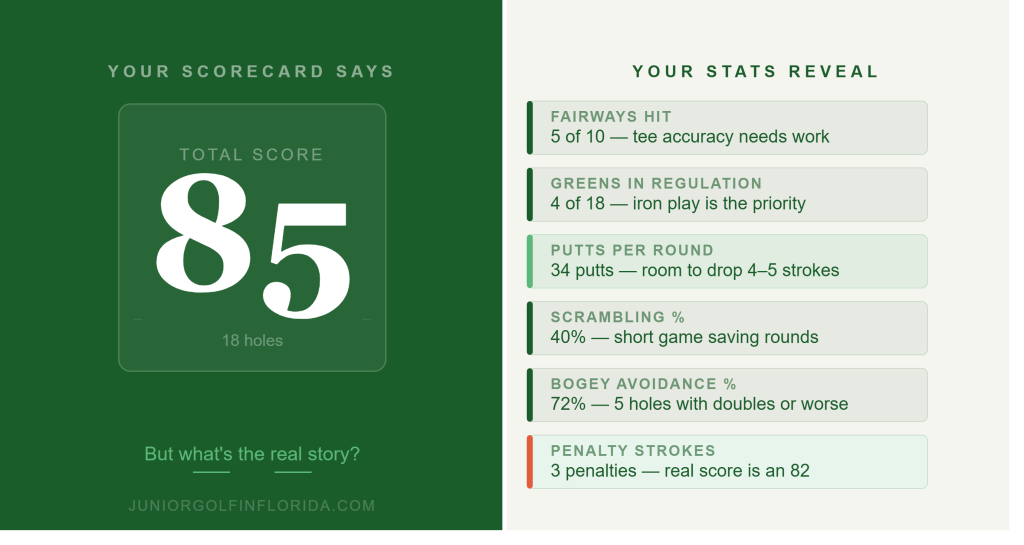
It’s tempting to judge a round entirely by the final number. But a 42 on the front nine doesn’t tell you much on its own. Was it putting? Tee shots? Wedge play? Three-putts on every other hole?
The most reliable way to measure junior golf improvement combines multiple indicators — tournament performance, scoring trends, and coaching evaluations — rather than focusing on any single number. Stats give you that fuller picture. IJGA
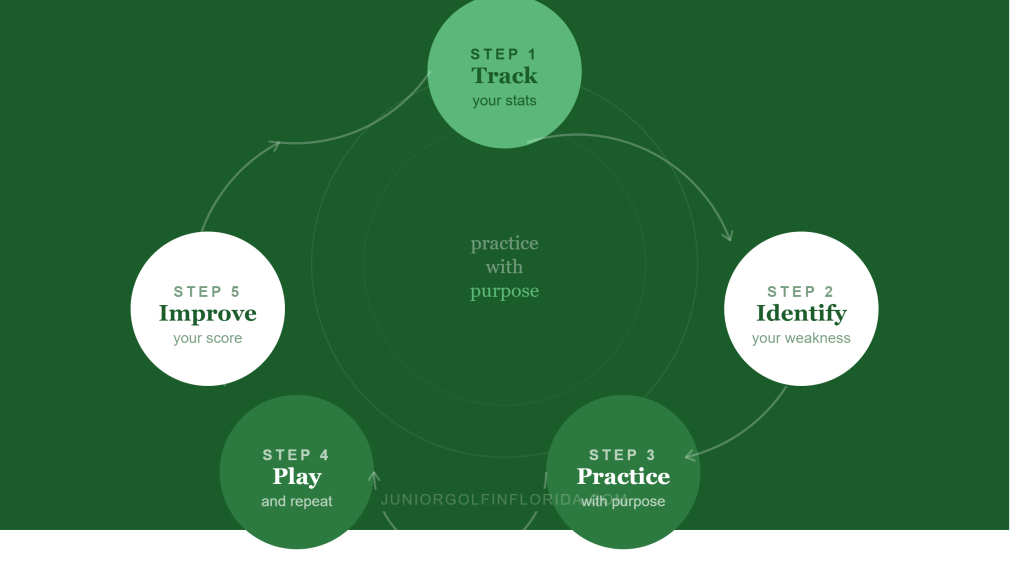
They also shift the focus from results to process — one of the most important mental transitions a junior golfer can make. Instead of obsessing over the score, your golfer starts asking: Where am I actually losing strokes?
That question, asked consistently over time, is what separates juniors who plateau from juniors who keep improving.
The 6 Stats Every Junior Golfer Should Be Tracking
These stats are simple enough to record during a round and meaningful enough to change how your junior practices.
1. Fairways Hit (FH%)
Did the tee shot land in the fairway? Track yes or no on every par 4 and par 5. For beginners, the goal isn’t hitting a specific percentage right away — it’s building awareness of whether tee shot accuracy is setting up easy holes or difficult ones. For competitive juniors, FH% tracked across multiple rounds reveals patterns: certain clubs, certain conditions, certain tee box situations that consistently cause trouble.
2. Greens in Regulation (GIR%)
A green is “in regulation” when your golfer reaches the putting surface in two fewer strokes than par — one shot on par 3s, two on par 4s, three on par 5s. This is one of the most telling stats in golf at any level. A low GIR% almost always points directly to iron play or approach shots as the priority area for improvement. If your junior is missing greens consistently, the short game is working overtime to save every hole.
3. Putts Per Round (PPR)
Count every putt on every hole. PGA Tour players average around 29 putts per round. A junior averaging 36 or more per round has a clear and immediate place to focus practice time — and it usually isn’t the driving range. Reducing putts per round is one of the fastest ways for any junior golfer to drop strokes without changing their swing.
4. Scrambling Percentage
When your golfer misses a green, do they still make par? Scrambling measures how often they successfully get up and down from off the green. This stat rewards short game ability, creativity, and mental toughness under pressure. For younger or developing juniors, a strong scrambling number can compensate significantly for weaker ball-striking and keep scores competitive while the long game catches up.
5. Bogey Avoidance Percentage
What percentage of holes are played in bogey or better? This stat measures consistency — the ability to avoid the big numbers that quietly wreck a round. A double bogey on one hole can erase two or three hard-earned pars elsewhere. Consistency across rounds matters just as much as low scores, and bogey avoidance is one of the clearest ways to measure it at the junior level. For beginners, tracking this number builds course management instincts. For competitive players, it’s a direct indicator of mental discipline and decision-making under pressure.
6. Penalty Strokes Per Round
Water hazards, out of bounds, lost balls — penalty strokes quietly destroy rounds and almost never stand out clearly on a basic scorecard. A junior who shoots an 85 with four penalty strokes is really playing closer to 81 ball-striking golf. Tracking penalties over time reveals course management habits: risky club selections off the tee, aggressive lines over water, poor decisions in unfamiliar conditions. This is one of the most overlooked stats at the junior level, and one of the most actionable. Without proper stat tracking, it’s nearly impossible to know where a golf game needs improvement — and penalty strokes are one of the first places to look.
Going Deeper: For Competitive Juniors With Bigger Goals
If your golfer is playing tournaments regularly — through FSGA, US Kids Golf, the Hurricane Junior Golf Tour, or other Florida junior golf tournaments — a few additional stats can sharpen the picture considerably.
Sand Save Percentage measures how often your junior gets up and down from a greenside bunker. Many juniors avoid bunkers mentally but never actually practice escaping them efficiently. Tracking this number makes the gap visible — and gives the coach something specific to work on.
Up-and-Down Percentage (Non-Bunker) is similar to scrambling but specifically from off-green situations not involving sand — chipping from rough, fringe, or tight lies around the green. This tells your junior golf coach exactly where short game work needs to go.
Scoring Average by Round is critical for multi-day events. College coaches prioritize scoring averages from multi-day tournaments and want to see consistency over multiple rounds, not just one strong performance. If your junior consistently plays well in round one and fades in round two, that’s a stamina, mental game, or course management issue worth identifying and addressing early.
Stats and the Road to College Golf
For families with collegiate aspirations, stat tracking takes on another dimension entirely.
D1 rosters are now capped at nine players, and coaches are filling spots earlier than ever. The players who earn those seats are the ones coaches already know, trust, and have evaluated over time. A junior who trains with intention — and can demonstrate a track record of measurable improvement — stands out in that environment.
A strong college golf recruiting resume is results-forward: tournament scores, scoring average, and national ranking. Coaches want the numbers first. But behind those numbers should be a junior who actually understands their own game — who can speak confidently to what they’re working on and why.
Platforms like Junior Golf Scoreboard track tournament results and scoring averages that college coaches actively use when evaluating recruits. Building a consistent stat-tracking habit early means your junior arrives at that conversation with real data to back up their game.
Several of Florida’s most respected coaches are already weaving stat-awareness into how they develop players. Rod Perry, PGA, one of Florida’s most accomplished instructors, emphasizes practicing with competitive purpose — and knowing where strokes are lost is central to that mindset. Justin Blazer, PGA, Director of Instruction at Duran Golf Club and head of the U.S. Kids Golf Space Coast Local Tour, builds game awareness into his programs from the earliest levels. Patrick Leahy, PGA, with over 30 years coaching juniors in Ocala, uses personalized performance data to guide every stage of development. Jessica Schnebly and Brianne Murphy are among the Florida coaches helping juniors at every level connect what happens on the course to what happens in practice.
Find all of them in the Junior Golf in Florida coach directory.
How to Start Tracking Today
You don’t need an app on day one. Start with a simple sheet — one row per round, with columns for date, course, score, fairways hit, greens in regulation, total putts, and penalty strokes. After five rounds, patterns will emerge that no amount of range time would have revealed.
From there, apps like 18Birdies or the Grint can automate the process and give your junior benchmarks against players their age. For serious competitive juniors, Junior Golf Scoreboard tracks tournament scoring averages that college programs use when building their recruiting lists.
The goal isn’t to overwhelm your golfer with numbers. It’s to give them a language for their own game — so that every practice session has direction, and every round teaches them something new.
Get the Free Junior Golf Guide
If you’re a Florida golf family building your junior’s development plan, our free Junior Golf Guide is a great place to start. It covers programs, coaches, tournaments, and resources across the state — delivered straight to your inbox.
👉 Grab your free copy at The Junior Tee
Ready to find coaches, tournaments, and programs near you? Browse the full directory at JuniorGolfInFlorida.com.