When the Yardage Card Lies: What Every Parent Caddie Needs to Know About Course Conditions
May 4, 2026 7 min read
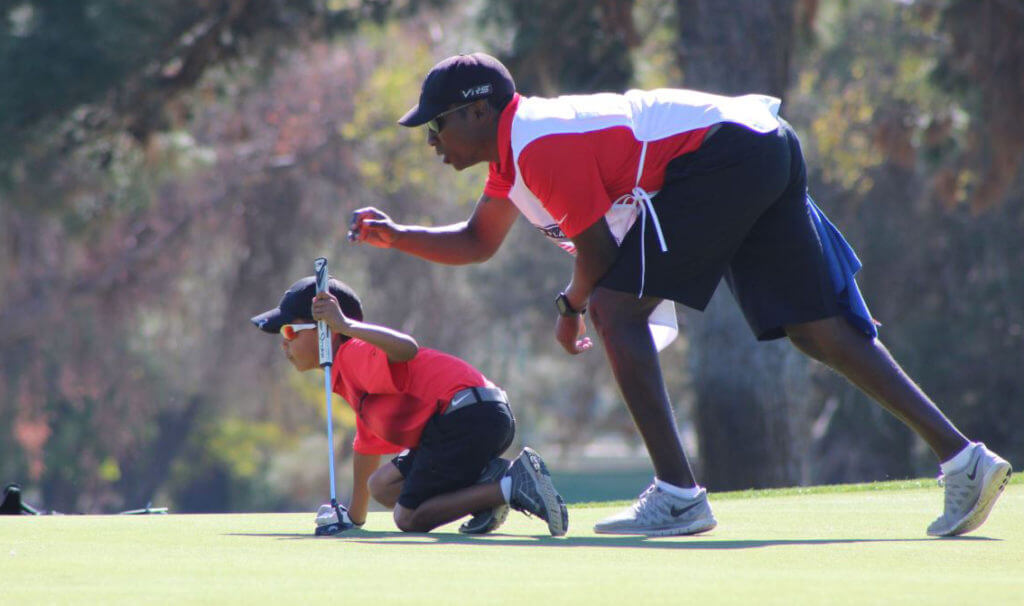
You did everything right. You built the yardage card. You tracked the carry distances. You showed up prepared. And then your 11-year-old flushed a 7-iron over the green on a hole that was supposed to be a 7-iron — and you watched a birdie chance become a bogey. Welcome to one of the most humbling […]
You did everything right.
You built the yardage card. You tracked the carry distances. You showed up prepared. And then your 11-year-old flushed a 7-iron over the green on a hole that was supposed to be a 7-iron — and you watched a birdie chance become a bogey.
Welcome to one of the most humbling lessons in junior golf parenting: the yardage card only tells half the story.
This is a situation thousands of parent caddies run into every season — from FSGA qualifying events to local HJGT tournaments across Florida. Ball striking gets sharp. Scores get competitive. And suddenly, the gap between 1st and 3rd place isn’t about swing mechanics at all. It’s about course intelligence — reading conditions your yardage card simply cannot capture.
Let’s break this down in a way that actually helps you on the bag.
The Hard Ground Problem Nobody Talks About
Here’s the physics that caught you off guard this past weekend.
A standard yardage card measures carry distance — how far the ball travels through the air. But on a scorching Florida summer day when the fairways are baked concrete-firm, carry is only part of the equation. The ball lands and keeps going.
Research published in the International Journal of Golf Science confirmed what you felt this weekend firsthand: dry, firm course conditions dramatically increase fairway rollout, and that same firmness causes greens to reject approach shots that would otherwise hold on a softer surface. On the flip side, wet or soft conditions do the opposite — limiting rollout and letting the ball stop near its landing spot.
On a firm-ground day, your son’s 7-iron “carry distance” might be accurate — but the total distance he’s actually covering could be 10–20 yards longer than what your card says. Club down. Every time.
The formula is simple but easy to forget in the heat of competition:
Total Distance = Carry Distance + Rollout
And rollout changes based on firmness, slope, wind, and even the angle the ball lands at. Golf course management training programs for teen and junior players emphasize pre-round condition checks for exactly this reason — because a yardage card built at home doesn’t account for what the course is doing that day.
The Pre-Round Walk Is Your Cheat Code
Before the first tee shot, most parent caddies are taping on bib numbers, checking the scorecard, and managing nerves. That’s understandable.
But a five-minute condition check during warmup can reset your entire strategy. Here’s a simple field test:
- Tap the ground with your foot near the practice green. Does it feel like grass or pavement? If it’s firm, budget for extra rollout on every approach.
- Watch a few warm-up chips from other players. Are balls releasing past the pin or stopping quickly?
- Check the greens on the first two holes. Are they holding pitch marks? If not, plan to land everything short and let the ball run up.
- Ask the starter or a club employee what the course setup is — whether they’ve been watering, how long the greens are running. They usually tell you.
This is what caddies on tour call “reading the table” before the meal even starts. Research on teen golf decision-making makes clear that players who study course conditions before the first shot make smarter decisions throughout the round — not just on the first few holes.
Real Parent Caddies Weighed In — Here’s What They Said
When this exact question was posed to a community of junior golf parents, the responses were pointed, honest, and in many cases — pointed directly at us, the parent caddies.
One parent put it plainly:
“The one who does the work does the learning. Let him figure it out — let him make the decisions and be responsible for the result.”
Several others echoed the same theme: by age 11, your role on the bag is shifting. Your job is no longer to make the call — it’s to give the information and step back.
Another parent shared how a specific phrase changed everything for their son: “Here’s the facts: 95 to the pin, short side left, missing here is an easy up and down.” Then the player selects the club. That parent reported clear improvement once they stopped completing the thought for their kid.
A third put it this way:
“Put on your poker face. Have them experiment and take ownership. This is the age you start separating yourself and preparing them for when it’s just them and their decisions. Course management is a critical component of scoring well.”
This lines up with what research on youth athlete decision-making consistently shows. A systematic review in the National Institutes of Health library found that high-level young athletes demonstrate greater accuracy in decision-making and are better at adjusting to complex situations — and that this skill is developed through real-game practice scenarios, not just told to them from the outside.
In other words: your 11-year-old learns course management by doing it, not by watching you do it from two steps back.
Build a Conditions-Adjusted Yardage System
Your existing yardage card isn’t useless — it just needs a second column.
Here’s a practical framework to build on it:
| Condition | Adjustment |
|---|---|
| Firm/dry fairways | Club down 1; expect 10–20 yds extra roll |
| Hard greens (ball not holding) | Land 5–10 yds short, let ball chase to pin |
| Into wind | Add 1–2 clubs |
| Downwind | Club down 1–2 |
| Downhill approach | Subtract 5–10 yds carry; plays shorter |
| Uphill approach | Add 5–10 yds; plays longer |
Take this table to the range after your next round and test it with your son. Hit 3–5 solid shots per club on a dry afternoon and chart not just where they land but where they stop. That rollout number is your missing data point.
This is the same methodology recommended by experienced junior golf parents — range sessions to lock in true total distances, not just carry numbers, and then applying course-specific adjustments at each event.
The Bigger Shift: From Caddie to Coach on the Bag
Here’s the part that’s hardest to hear, especially when you’ve invested hundreds of hours on the bag and genuinely want to help:
Your highest-value move right now might be to say less and ask more.
Instead of: “Take a 7-iron, it’s 140 to the pin.”
Try: “It’s 140 to the pin, ground is hard, wind left to right. What are you thinking?”
Let him answer. Affirm the logic, not just the outcome. And if the shot goes long? That’s data. That’s a lesson no range session can replicate.
The HJGT — one of Florida’s largest junior golf tour operators with over 350 multi-day tournaments annually — points out that golf places decision-making responsibility directly in the player’s hands in a way almost no other sport does. Every shot is owned by the player. Every score belongs to them.
The parent caddie’s job is to help them own it well — not to own it for them.
Florida-Specific Conditions Worth Knowing
If you’re competing across Volusia, Orange, Hillsborough, or Sarasota counties, Florida’s summer climate creates specific challenges worth building into your strategy:
- Morning humidity vs. afternoon heat: Greens may be softer in early tee times due to overnight moisture, then firm dramatically by afternoon. Your 8am yardage won’t match the 1pm reality.
- Bermuda greens: Common on Florida courses; they tend to be faster and firmer than bent grass, with more grain to read.
- Shade vs. sun: A green shaded by trees all morning may hold shots; the same green with full afternoon sun could be a frying pan.
If you’re exploring courses across Florida for tournaments and want to know which venues your son may encounter, check our Florida Junior Golf Tournament Directory for a growing list of competitive events by age group.
The Win Is Coming — But It’s Not Just on the Scorecard
One of the most reassuring things said in the parent community conversation was this:
“Trust me — if they have a passion for the game, they will be playing for a very long time, including many competitions.”
The 2nd and 3rd place finishes where you over-clubbed on firm greens? That’s not failure. That’s the tuition payment for a skill your son is going to carry for the rest of his competitive career.
The parents who figured out the conditions math, gave the information, stepped back, and let their kids own the decision — those are the families producing players who can compete without a caddie in a few years. And in Florida junior golf, that day comes fast.
Build the second yardage column. Run the pre-round conditions check. Ask more, tell less.
First place is a conditions-adjusted decision away.
Looking for more junior golf resources across Florida? Explore our Junior Golf Coach Directory, browse upcoming Florida junior tournaments, and follow us for weekly content built for junior golfers and the families supporting them.